
Home & Tax Strategy
Section 01 | Buying, Building & Financing
Episode 05
Mortgage Points: When Can You Deduct Them?
By Colleen Kamolnik
Mortgage Points: When Can You Deduct Them?
If you've been shopping for a mortgage lately, you've probably heard lenders talk about paying points to lower your interest rate.
It sounds pretty straightforward.
Pay a little more upfront, get a lower interest rate, and potentially save money over the life of the loan.
But here's something I want you to think about.
Just because mortgage points may be tax deductible doesn't automatically mean paying them is a good financial decision.
My husband and I are comparing financing options as we prepare to build our next home, and this is exactly the kind of thing I look at when evaluating loan terms.
Because sometimes what looks like a tax benefit isn't necessarily the best use of your money.
Let's talk about how mortgage points work, when they're deductible, and how to decide whether they're worth paying.
1. What Exactly Are Mortgage Points?
Mortgage discount points are upfront charges you pay to your lender, generally in exchange for a lower interest rate.
One point typically equals 1% of your loan amount.
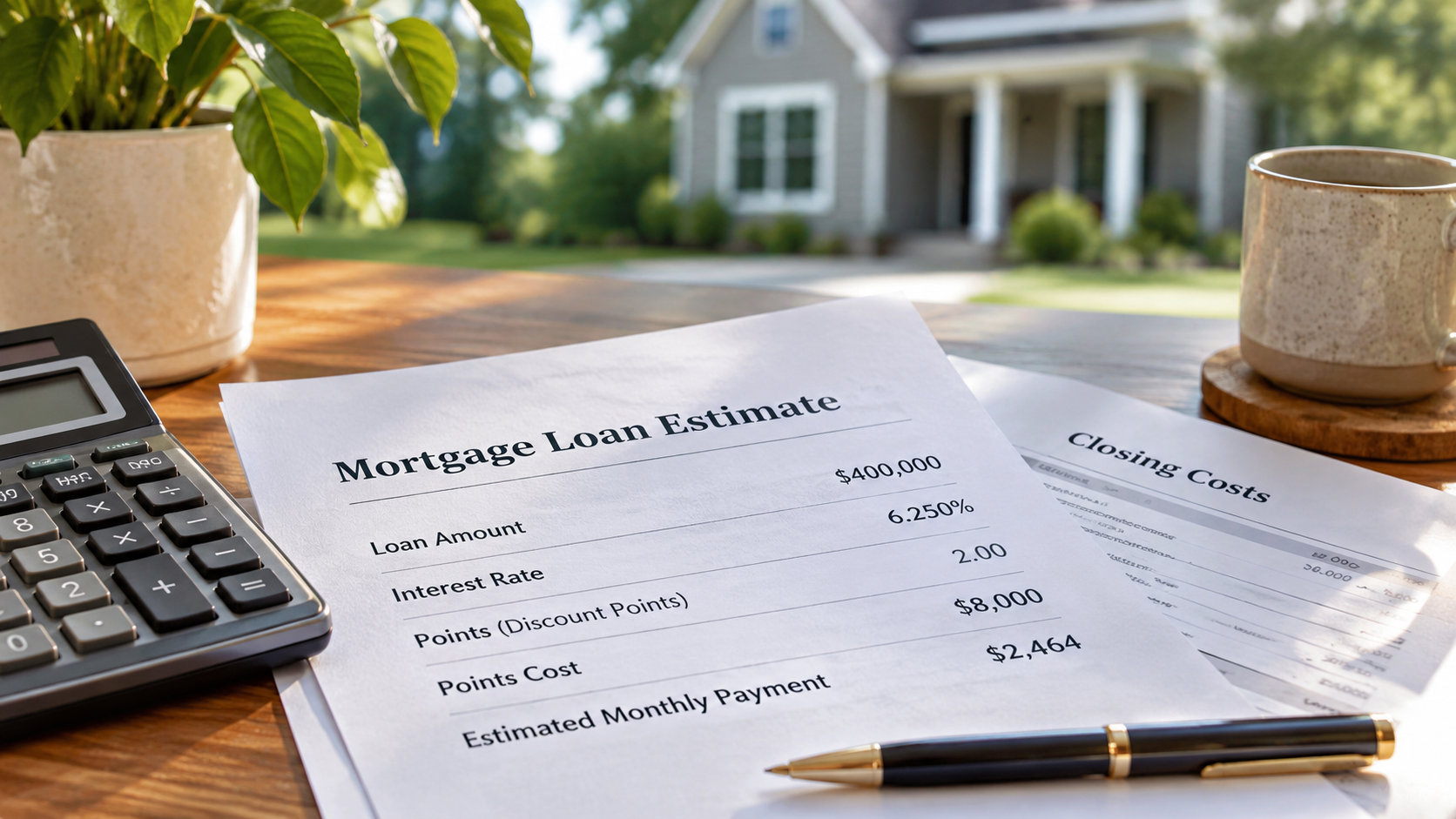
For example, let's say you're borrowing $400,000.
Mortgage points vs Upfront cost
1 point - $4,000
2 points - $8,000
3 points - $12,000
The idea is that by paying more upfront, you'll receive a lower interest rate and potentially lower monthly mortgage payments.
But how much your rate decreases depends on the lender and the loan terms.
One point doesn't automatically mean your interest rate drops by one percentage point.
That's an important distinction.
2. Are Mortgage Points Tax Deductible?
Here's where things get interesting.
The IRS generally treats qualifying mortgage discount points as prepaid interest.
That means they may be deductible as home mortgage interest if you itemize deductions.
But there's a catch.
Some mortgage points can be deducted in the year you pay them. Others must be deducted over the life of the loan.
The timing depends on the type of mortgage, how the loan proceeds are used, and whether you meet the IRS requirements.
For example, qualifying points paid to purchase or build your primary residence may be fully deductible in the year paid.
However, several conditions must be satisfied.
Among other requirements:
The mortgage must be secured by your principal residence.
The loan must be used to buy or build that residence.
Paying points must be an established practice in your area.
The points cannot exceed the amount generally charged.
The points must be properly calculated and disclosed.
You must meet the applicable requirements regarding funds paid at closing.
The IRS also has rules preventing certain lender fees from being treated as deductible points simply because they're labeled that way.
So don't assume every charge listed as a point on your closing disclosure automatically qualifies.
And remember, even if the points qualify as deductible mortgage interest, you generally must itemize deductions to receive a federal income tax benefit.
3. What If You're Refinancing Your Mortgage?
This is where the tax treatment can change.
Let's say you refinance your existing mortgage to obtain a lower interest rate.
You decide to pay $3,000 in qualifying discount points.
Can you deduct that entire $3,000 immediately?
Generally, no.
Points paid when refinancing are usually deducted over the life of the new loan.
For example, if you pay $3,000 in qualifying points on a 30-year refinancing loan, the amount allocated over the full loan term would generally be:
$3,000 ÷ 360 months = $8.33 per month
For a full year of payments, that's approximately $100 in potentially deductible points.
That's a very different tax benefit from deducting the entire $3,000 upfront.
There are exceptions, including certain refinancing situations where proceeds are used to substantially improve your primary residence.
But the important takeaway is that purchasing, building, and refinancing don't necessarily receive the same treatment.
4. Let's Talk About Whether Paying Points Is Actually Worth It
This is the part I think homeowners should spend the most time considering.
Let's say your lender gives you two options.
Option A: No mortgage points
You take the higher interest rate but pay nothing extra upfront.
Option B: Pay mortgage points
You pay $4,000 upfront and reduce your monthly payment by $75.
Which option is better?
Well, that depends on how long you plan to keep the mortgage.
Let's calculate the simple break-even point.
Upfront cost of points - $4,000
Monthly payment savings - $75
Simple break-even period - 53.3 months
That's approximately four years and five months.
In other words, it takes a little over four years for the monthly payment savings to recover the $4,000 you spent upfront.
If you keep the mortgage for ten years, the points may be worthwhile.
But what if you refinance after two years?
Or sell the home after three?
You might not have held the loan long enough to recover that upfront cost.
And that's before considering the tax treatment, the time value of your money, and any differences in how much principal you've repaid.
5. Does the Tax Deduction Change the Calculation?
Potentially, yes.
But here's where I see people make mistakes.
They hear that mortgage points are tax deductible and assume that makes paying them a good financial decision.
A tax deduction doesn't mean the government reimburses you for the entire expense.
Let's say you pay $4,000 in qualifying points.
If you're eligible to deduct the entire amount and the deduction produces a 24% marginal federal income tax benefit, the potential federal tax savings could be approximately $960.
You still spent $4,000.
Your estimated after-tax cost would be $3,040, before considering state taxes or other limitations.
And if you take the standard deduction, those points might not create any additional federal income tax savings at all.
That's why the decision should be based on the complete financial picture.
Not just the potential tax deduction.
6. What If Your Lender Calls Something a Point, but It Isn't Really Interest?
This is another area worth understanding.
Your loan estimate or closing disclosure may contain several charges, including:
Discount points
Origination fees
Processing fees
Underwriting fees
Appraisal fees
Not all of these charges are deductible mortgage interest.
The IRS looks at the nature of the expense, not simply what the lender calls it.
For example, appraisal fees and charges for certain loan-processing services generally aren't deductible as mortgage interest.
So before assuming a charge qualifies, make sure you understand what you're actually paying for.
7. What Should You Ask Your Lender?
Before agreeing to pay mortgage points, I'd recommend requesting two loan estimates.
One with points and one without.
Then compare:
The interest rate on each loan
Total upfront closing costs
Monthly principal and interest payments
The simple break-even period
Your expected ownership period
Whether you might refinance in the next few years
Your available cash and other financial priorities
And don't forget to consider whether paying points will affect the cash you have available for other expenses.
This can be particularly important when you're building a home and managing construction costs.
My Biggest Takeaway
Never spend money solely because someone tells you it's tax deductible.
Mortgage points can be a useful financing tool.
And in the right situation, they may offer both interest savings and tax benefits.
But whether they're worth paying depends on the loan terms, your financial circumstances, and how long you expect to keep the mortgage.
For my husband and me, this is just one more piece of the financing puzzle as we prepare to build.
The goal isn't simply to find the loan with the biggest tax deduction.
It's to find the financing arrangement that makes the most financial sense.
And understanding the tax implications is part of making that decision.
Coming Next: Buying Land Now and Building Later
What if you've found the perfect piece of property but aren't ready to start construction?
Does the interest on your land loan qualify for a deduction?
What about property taxes, clearing the land, installing a driveway, or preparing the building site?
That's what we're covering next in our Home & Tax Strategy series.
Follow the full series at joltstrategies.com/blog.
IRS references
The mortgage points deduction rules, including immediate deduction requirements and refinancing treatment, are explained in:
About JOLT Strategies
JOLT Strategies provides outsourced accounting, tax strategy, and advisory services to growing businesses and their owners. We believe good tax planning should happen throughout the year, not just when it's time to file a return.
This article is for general educational purposes and does not constitute individualized tax advice. Tax treatment depends on your circumstances and applicable tax law.
Related JOLT services
READY FOR THE NEXT STEP?